
Working and travelling: a self-experiment on the Shetland Islands
Everywhere you hear about the benefits of remote working; it can promote creativity and motivation, improve work-life balance, and lead to higher satisfaction and well-being through more autonomy and freedom.
But is that really the case, or is it perhaps difficult to balance work and life when you are on the road for a longer period? Or does the confinement eventually become annoying because your partner is having a video conference at the same time? Anja wanted to try it out and reports on her self-experiment.
I am writing this article from the camper van. It is storming and raining right now, otherwise I would probably be sitting outside. I have the privilege of being able to take my work with me on the road. Together with my partner, I am spending a while – seven weeks, to be precise – in the camper van on the Shetland Islands.
Pure nature outside – laptop and headset inside
The rugged coastal landscape, green hills, and impressive cliffs provide a perfect backdrop for productive work and offer me new inspiration. With my mobile office, sometimes surrounded by sheep and Shetland ponies and the amusing squawking of nesting puffins in the background, I can enjoy the beauty of the Shetland Islands without neglecting my professional obligations.
From satellite internet and solar power – good preparation is key
To ensure that working from the van would be successful, some preparation was necessary beforehand: two additional solar panels were mounted on the vehicle roof for power supply. A small, mobile router with a SIM card was already on board. From previous visits to the islands, I knew that the mobile network on the islands is not always reliable, so a satellite internet solution was acquired as the main connection. Now, nothing stood in the way of the adventure in the far north just below the Arctic Circle.
At first, it was a bit strange to organize ourselves in our roughly 12m² space. Who sits where? Who needs to make a call when? However, we quickly figured it out, and I liked to use our kitchen counter as a standing desk whenever spatial separation was necessary. The noise-cancelling headphones we brought along did their part, so that the conversation partners on the other end usually did not even notice that two people were having calls.
Coordination with colleagues in the office was not much different than usual, as I generally work from home, and we communicate a lot via MS Teams. Our weekly check-in was occasionally supplemented with a small video tour of our current location.
I did not want to do without my paper notebook in the van either, as I can simply remember and process handwritten notes better. However, all the necessary documents for daily work were available to me digitally, partly thanks to the kind support of colleagues in the office.
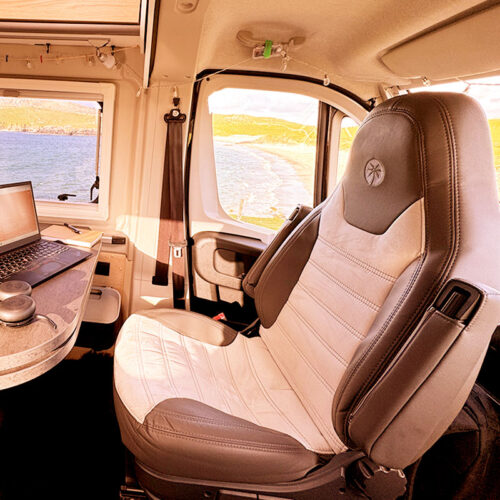
Therefore, I only had the limitation of not having a second large screen, which made some tasks a bit more cumbersome. And of course, the time difference meant that the workday started an hour earlier on site. However, this also left plenty of time after work to explore the islands.
Today, after more than half of my trip, I draw an entirely positive conclusion: this experience has shown me that working on the move is not only possible but can also be enriching. The combination of breathtaking nature and professional flexibility offers new perspectives and shows me how wonderfully work and adventure can go hand in hand.
Open communication with the employer broadens horizons
Of course, this type of mobile working requires careful preparation: a longer absence must be planned and coordinated internally well in advance. Let’s be honest – not all tasks can be completed on the road, and a certain degree of flexibility is also needed from colleagues in the office. It is also essential to be well informed about the conditions in the destination country and to prepare adequately for potential technical difficulties so that they can be resolved quickly and efficiently without affecting the travel experience.
When company culture goes mobile –
and reveals what truly defines us
For us at Feldus, this form of working was new territory – and it turned out to be a great success. It was only while writing this article that we realized how authentically we live the values we defined six years ago: We have the courage to try something new and were open to Anja’s idea. We communicate in an open and honest manner, and so we discussed the pros and cons of this adventure as a team and developed a solid plan together.
We accept responsibility – in this case, for exploring new paths, fostering strong collaboration, and evolving our work culture. We were particularly impressed by the sense of responsibility with which Anja carried out her tasks while on the road. This project demonstrates how trust, flexibility, and thorough preparation can make new ways of working not only possible, but successful.
Have you already tried similar models in your company or are you thinking about it? We look forward to exchanging ideas with other organizations that enable new ways of working – feel free to contact us!

