
How One Room Changed
the Way We Work
Many conference rooms today still look like they did 20 years ago: functional, neutral, rarely inspiring. Yet our working world has long since changed. Communication has become more flexible, and the need for spaces for exchange and retreat has grown. Today, rooms should do more – they should foster interaction, enable focus, and create a positive atmosphere.
At Feldus Asset Management, we faced this very question: What to do with a rarely used meeting room that was neither functional nor atmospheric for our daily work? The answer: a complete redesign together with our long-standing partner Bender GmbH, specialists in interior architecture and design concepts.
A Room with Little Appeal
The starting point was uninspiring: a plain table, uncomfortable chairs, a docking station and screen – plus poor acoustics that made every conversation echo unpleasantly. No wonder the room was barely used.
On top of that, the design dated back to the 1980s: window frames in lilac and turquoise-painted metal profiles of a fragmented glass partition. Visually chaotic and far from our current design standards. The result: a room without a clear function and without any appeal.
New Thinking, Trusted Partner
It quickly became clear that we needed more than just new furniture. Together with Bender GmbH, with whom we’ve had a long-standing collaboration, we developed a new concept: a modern meeting lounge with versatile uses; for informal exchanges, as a retreat for phone calls or focused work, and for smaller meetings or workshops.
The goal was a professional yet homely atmosphere. The room should invite communication – but also offer calm. Design flaws were to be elegantly integrated or deliberately minimized.
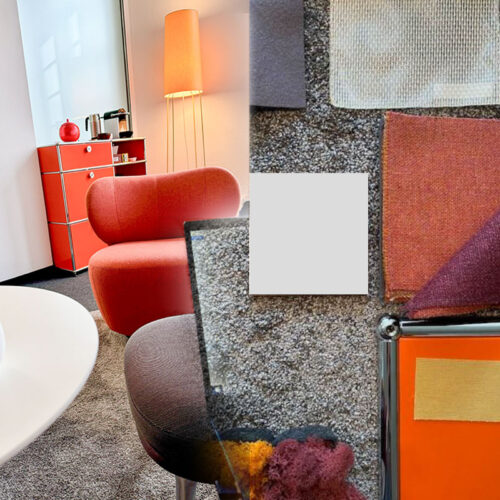
In joint workshops, mood boards and material concepts were developed, forming the basis for carefully selected furniture, colors, acoustic elements, and zoning.
Design Meets Functionality
The result is an inspiring space: high-quality lounge chairs and armchairs, combined with portable, height-adjustable side tables, offer flexible use from one-on-one conversations to focused laptop work. An integrated coffee point invites short breaks.
A high-pile carpet not only improves acoustics but also structures the room. The challenge of the turquoise glass elements was solved with a semi-transparent acoustic curtain: it conceals what doesn’t fit the concept without sacrificing light and openness.
The color scheme also contributes to the successful transformation: orange, berry tones, and taupe create a warm base mood. Even the old lilac window frames now blend harmoniously into the overall design. A floor lamp with a textile shade adds a cozy accent.
And the acoustics? No longer a drawback, but one of the room’s key strengths, supported by additional acoustic elements in the adjacent open-plan office.
The transformation took only a few weeks and required no structural changes.
A Room That Makes an Impact
Today, the lounge is an integral part of our workday. It’s used daily for spontaneous conversations, confidential calls, short breaks, or focused solo work. Full-day workshops have also been held here with consistently positive feedback.
The response? Overwhelming! Function and atmosphere were perfectly combined in this project. The new room quality is not only visible but tangible: the work atmosphere is more relaxed, conversations are more pleasant, and the space is more versatile.
Our Experience & Recommendation:
Spaces Need Intention
Redesigning our meeting lounge was more than just a visual upgrade. It was a statement about how we want to work and interact. What did we learn from the project?
Above all: spaces have an impact, for better or worse. And they can be intentionally designed if you take both function and atmosphere seriously.
Our top tip for other companies: align internally early on about the room’s purpose. What should it achieve? Who is it for? What feeling should it convey? Clear answers to these questions make the design process more focused and the result more tailored.
Also important: bring in an experienced partner. A good interior designer thinks beyond colors and furniture – to usage scenarios, materials, lighting, and acoustics. Being open to professional suggestions pays off in the end.
Our conclusion:
a well-designed space changes more than just the setting. It changes the way we work.

