
Key Regulations and Their Implementation in Germany
While Part 1 of our series provided a general overview of ESG in real estate asset management, Part 2 focuses on current and upcoming regulatory requirements for the German real estate sector. The emphasis is on existing buildings, as around 80% of the buildings that will still be in use in 2050 have already been constructed today and represent the greatest leverage for decarbonization. The latest UNEP Buildings Global Status Report (2025) underscores this urgency: The building sector accounts for around 34% of global energy-related CO₂ emissions and requires a significant increase in renovation rates to meet climate targets.1
Below, we summarize the key regulations relevant to Germany and place them in the EU context.
EU Taxonomy Regulation and National Implementation
The EU Taxonomy Regulation (Regulation (EU) 2020/852) aims to create transparency and direct capital flows towards environmentally sustainable economic activities. As a classification system, it defines clear criteria for identifying activities as “environmentally sustainable.” It applies to financial market participants such as funds, banks, and insurers, as well as companies subject to the Corporate Sustainability Reporting Directive (CSRD).
To be taxonomy-aligned, an activity must:
- Do no significant harm (DNSH) to other environmental objectives,
- Make a substantial contribution to one of the six environmental objectives,
- Comply with minimum social safeguards, and
- Meet technical screening criteria, such as belonging to the national top 15% most energy-efficient buildings (building permit application fully submitted before December 31, 2020) or aligning with a decarbonization pathway, see below.
Six environmental objectives of the EU Taxonomy:
- Climate change mitigation
- Climate change adaptation
- Sustainable use and protection of water and marine resources
- Transition to a circular economy
- Pollution prevention and control
- Protection and restoration of biodiversity and ecosystems
Examples for real estate:
- Acquisition & Ownership: Belonging to the top 15% of the national buildings for which the building permit application was fully submitted before December 31, 2020 (verified via EPC A or benchmark studies).
- Renovation: Primary energy reduction of at least 30%.2
In Germany, implementation occurs indirectly through CSRD reporting obligations and financial market regulations. There is no separate German law for the taxonomy, but banks and investors increasingly use the criteria as a basis for lending and investment decisions.
Corporate Sustainability Reporting Directive and German Law
The CSRD requires large companies to provide comprehensive sustainability reporting in line with the European Sustainability Reporting Standards (ESRS). To qualify as a large company, at least two of the following criteria must be met:
- Balance sheet total > €25 million
- Net revenue > €50 million
- More than 250 employees
Implementation in German law was adopted in September 2025 and is expected to take effect on January 1, 2026.
- Wave 1: Companies with ≥ 1,000 employees must report for fiscal year 2025.
- Other large companies: Reporting obligation from fiscal year 2027.
- Listed SMEs: From fiscal year 2028 (“Stop-the-Clock” rule).3
Reports are subject to assurance by auditors or approved assurance providers (initially “limited assurance,” later “reasonable assurance”).
For real estate companies, CSRD means significant data requirements: In addition to their own consumption and emissions data, Scope 3 emissions from the value chain often need to be captured – such as tenants’ energy and water consumption. Green lease clauses are increasingly used to secure data exchange, efficiency targets, and building standards contractually.
Sustainable Finance Disclosure Regulation (SFDR)
The SFDR (Regulation (EU) 2019/2088) aims to ensure transparency on sustainability risks and impacts in financial products and prevent greenwashing. Financial market participants must disclose how they consider sustainability aspects. Classification is based on:
- Article 8: Products promoting environmental or social characteristics
- Article 9: Products with a sustainable investment objective
For real estate, SFDR matters when seeking ESG-compliant financing (e.g., Green Loans under LMA or Green Bonds). KfW loans only qualify as “Green Loans” if embedded in a Green Loan Framework with clear KPIs and reporting.
In November 2025, the European Commission published a draft for “SFDR 2.0,” introducing new product categories and stricter minimum standards.4
EU Building Directive (EPBD) and German Building Energy Act (GEG)
The recast EU Building Directive (EPBD, EU/2024/1275) has been in force since May 2024. Germany has already implemented key elements through the Building Energy Act (GEG) but must establish binding Minimum Energy Performance Standards (MEPS) by May 29, 2026. EPBD requirements include:
- Improve 16% of the worst-performing non-residential buildings by 2030
- Improve 26% by 2033
- New buildings: Zero-emission standard from 2030 (public buildings from 2028)5
The GEG sets the goal of achieving climate neutrality in the building sector by 2045. Since January 2024, newly installed heating systems must use at least 65% renewable energy. For existing buildings, transition periods apply until 2026 in large cities and until 2028 in other municipalities. Likewise, municipal heating plans must be completed by June 30, 2026 for cities with more than 100,000 inhabitants and by June 30, 2028 for smaller municipalities. Fossil heating systems may only operate until 2045.6

Other National Initiatives
Funding programs: The Federal Funding for Efficient Buildings (BEG) supports the transition.
CO₂ Cost Allocation Act (CO₂KostAufG): In force since 2023, allocates CO₂ costs between landlords and tenants (tiered model based on efficiency classes).7
Mantelverordnung: Includes the Substitute Building Materials Ordinance (EBV) and the revised Federal Soil Protection Ordinance. In force since August 1, 2023, it standardizes the use of mineral substitute building materials and soil protection nationwide.8 Relevant for ESG strategies as it promotes circular economy principles and sets requirements for pollutant testing and documentation – key levers for sustainable renovation and demolition.
“Transition to a circular economy” is one of the six environmental objectives of the EU Taxonomy. DGNB certifications integrate this objective and offer ESG verification to demonstrate compliance with taxonomy criteria. This makes the Mantelverordnung an indirect building block for meeting ESG and taxonomy requirements.9
Carbon Border Adjustment Mechanism (CBAM): CBAM is part of the EU’s “Fit for 55” climate package and will offset CO₂ costs for imported materials such as steel, cement, and aluminum starting in 2026.
Under the “Omnibus Package I,” CBAM has been simplified: companies importing less than 50 tons of relevant materials per year are exempt – this applies to around 90% of previously obligated firms. For large importers, requirements remain in place, which may increase costs for certain building materials. As a result, recycling and circular economy solutions are becoming even more important.10
Political Context: COP30 and EU Interim Targets
The EU has proposed an interim target of –90% net GHG emissions by 2040 ahead of COP30 to secure the path to climate neutrality by 2050. This benchmark will further tighten requirements for real estate portfolios – particularly regarding renovation rates and decarbonization pathways.
COP30 took place from November 10–22, 2025 in Belém, Brazil, focusing on NDC implementation and climate finance.
Conclusion
The temperature increase recently projected by UNEP is significantly above the targets of the Paris Agreement. Climate action is not optional – it is a necessity, and Europe aims to be climate-neutral by 2050. For the real estate sector, this means that existing buildings must become ESG-compliant in the near term. Those who act early will not only safeguard the value of their assets but also unlock new opportunities in a changing market.
In the next part of our series, we will explore different perspectives and present practical solutions for ESG transformation.
Feel free to contact us for a discussion.
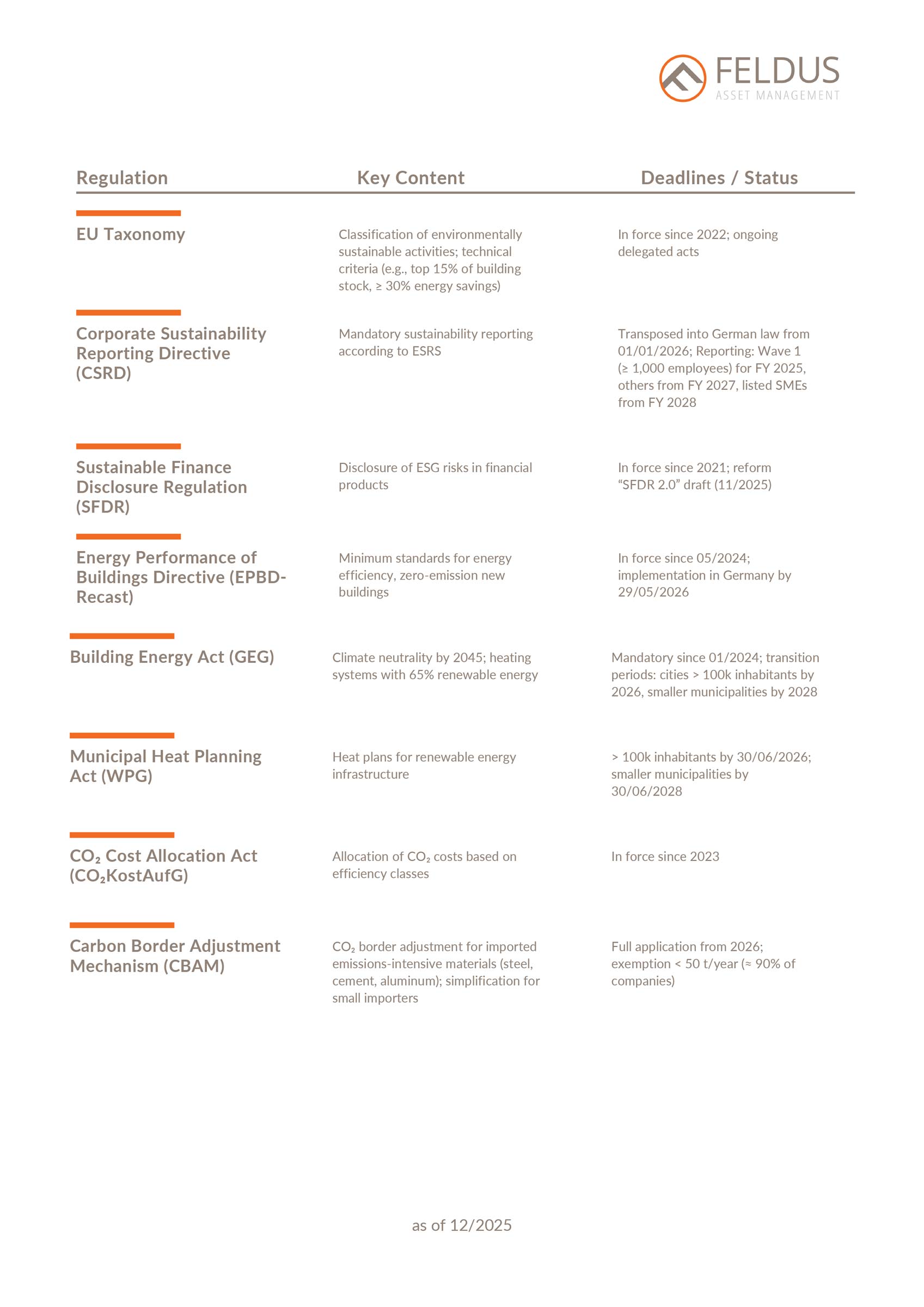
A tabular overview of the
ESG regulations
(click image to enlarge).
1 UNEP Buildings Global Status Report 2025
2 EU-Taxonomie VO (EU) 2020/852 + Delegierte Rechtsakte, EU Commission update Renewed Sustainable Finance Strategy and Green Recovery (14.03.2022)
3 CSRD (Richtlinie (EU) 2022/2464), Directive (EU) 2023/2775, DE-Umsetzungsgesetz 09/2025
4 EU-Kommission, SFDR-Review-Dokumente (11/2025)
5 EPBD-Recast (EU/2024/1275)
6 Wärmeplanungsgesetz (BGBl. 2024 I Nr. X)
7 CO₂KostAufG (BGBl. 2023 I Nr. X)
8 Mantelverordnung (BGBl. 2023 I Nr. X)
9 DGNB
10 Umweltbundesamt, Pressemeldung Nr. 38/2025 vom 23.10.2025

